| REF | MAD-001004Q |
|---|
Name: Cytokeratin 7 Antibody clone OV-TL 12/30
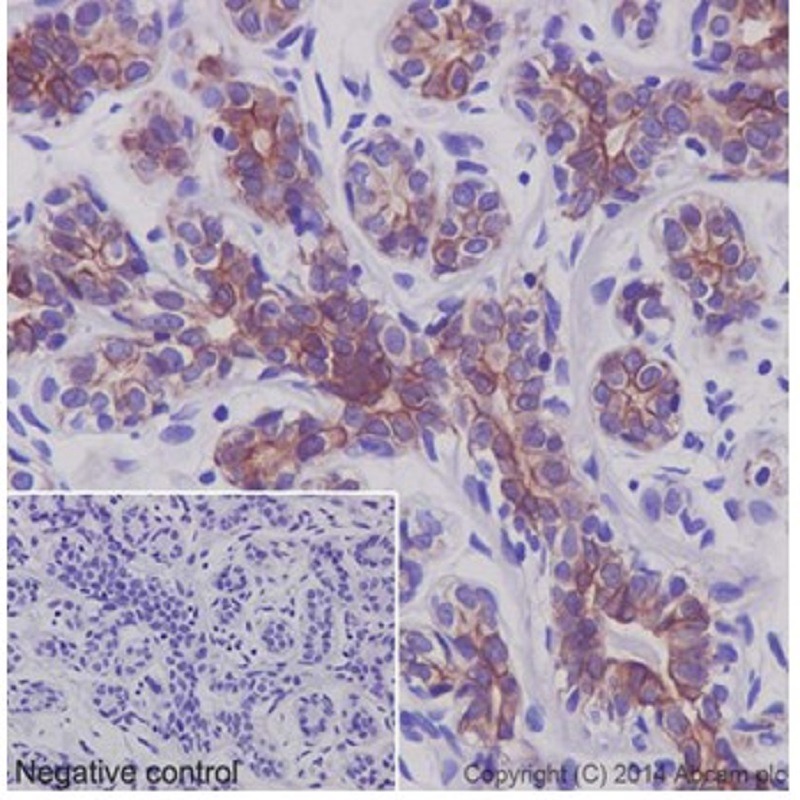
Description and aplications: Keratins (also known as cytokeratins) are intermediate filament/forming proteins that represents the main cytoskeleton of epithelial cells. They classically are classified based on Moll cataloging which grouped the basic-to-neutral type II keratins as K1–K8 and the acidic type I keratins as K9– K19. An updated classification including 24 types of keratins was then proposed in order to enable other mammalian species keratins to be added. This monoclonal antibody reacts specifically with the cytokeratin 7, immunostaining of the producing a protein band of 54 kD in the cytoskeleton of cell lines and uni-dimensional immunoblots. This antibody is useful to distinguish between different types of normal glandular epithelia as it marks the epithelia of lung and breast, being negative for colon and prostate. We have not observed any cross reaction with other cytokeratins and overall this antibody does not react with stratified squamous epithelium. In liver, hepatocytes are negative and the epithelial cells of the bile ducts are positive. This antibody reacts with numerous both benign and malignant epithelial lesions. Cytokeratin 7 is expressed in specific subtypes of ovarian adenocarcinomas, breast and lung carcinomas while the gastrointestinal tract, except stomach, are negative. Carcinomas arising from transitional epithelium also express cytokeratin, whereas prostate cancer is generally negative.
Composition: anti human keratin 7 mouse monoclonal antibody obtained from supernatant culture and prediluted in a Tris buffered solution pH 7.4 containing 0.375mM sodium azide solution as bacteriostatic and bactericidal.
Intended use : Immunohistochemistry (IHC) on paraffin embedded tissues. Not tested on frozen tissues or Western-Blotting
Immunogen: OTN II ovarian carcinoma cell line
حجم موجود: 3 / 7 / 12 میلیلیتر
مورد استفاده: ایمونوهیستوشیمی روی بافت پارافین. بر روی بافتهای فروزن یا وسترن بلات تست نشده است.
کلون: OVTL 12/30
ایزوتایپ: Mouse IgG1/kappa
کنترل مثبت IHC: کبد، سینه، تخمدان
قابلیت دیده شدن: سیتوپلاسمی و غشایی
روش پیشنهادی IHC:
شرایط نگهداری و پایداری : حداکثر 18 ماه؛ در دمای 2-8 درجه سانتیگراد نگهداری شود. فریز نشود.
این آنتیبادی متعلق به پنلهای تشخیصی DIGESTIVE، GYNECOPATHOLOGY، PLEUROPULMONARY و UROGENITAL است.