دسته: اقلام مصرفی ایمونوهیستوشیمی
نمایش 1–20 از 24 نتیجه
فیلتر ها-
PSW
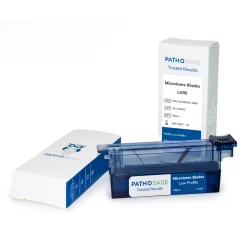
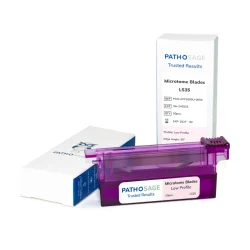
تیغ میکروتوم مدل LS35 برند PathoSage
نمره 0 از 5Intended use:
The low profile soft tissue microtome blade is intended for use in histology and pathology laboratories for the precise sectioning of soft tissue specimens with exceptional sharpness. It is designed to be used with compatible rotary microtomes to produce thin, uniform sections of biological tissue for microscopic examination and diagnostic evaluation. This blade is particularly suited for delicate or soft tissue types, providing clean cuts with minimal tissue distortion. Average number of slices per blade with 3 micron is 30 slices. Soft Tissue examples:- Skeletal Muscle (e.g., biopsies for myopathies)
- Adipose Tissue (e.g., liposarcoma diagnostics)
- Fibrous Connective Tissue (e.g., fibromas, scar tissue)
- Nerve Tissue (e.g., schwannomas, neurofibromas)
- Blood Vessels (e.g., vasculitis studies, angiosarcomas)
-
PSW
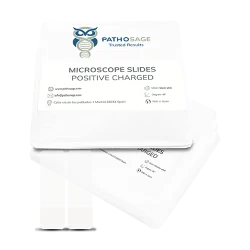
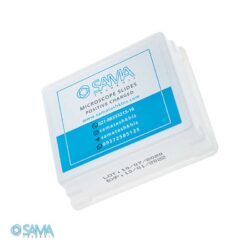
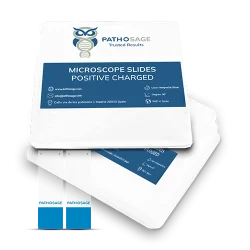
لام شارژ شده (°90) برند PathoSage
نمره 0 از 5Intended use:
Through a new process, positive-charged microscope slides provide several advanced benefits. These slides generate a permanent positive charge, electrostatically attracting frozen tissue sections and cytology preparations, effectively binding them to the slide. They form a bridge that encourages covalent bonds to develop between formalin-fixed sections and the glass. This enhances adhesion of tissue sections and cytological preparations to the positive charge glass slides, eliminating the need for special adhesives or protein coatings for better adherence.
-
PSW
لام شارژ شده (°45) برند PathoSage
نمره 0 از 5Intended use:
Through a new process, positive-charged microscope slides provide several advanced benefits. These slides generate a permanent positive charge, electrostatically attracting frozen tissue sections and cytology preparations, effectively binding them to the slide. They form a bridge that encourages covalent bonds to develop between formalin-fixed sections and the glass. This enhances adhesion of tissue sections and cytological preparations to the positive charge glass slides, eliminating the need for special adhesives or protein coatings for better adherence.
-
PSW
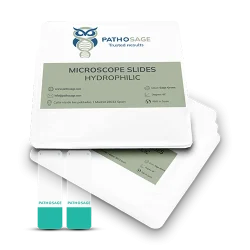
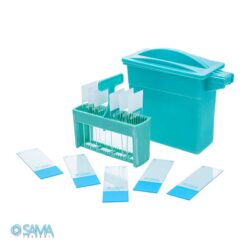
لام هیدروفیلیک (°45) برند PathoSage
نمره 0 از 5Intended use:
Hydrophilic adhesion slides effectively prevent tissues from detaching from the slides during high-temperature antigen retrieval or enzyme digestion procedures. These slides are ideal for tissues requiring strong adhesion, thanks to their hydrophilic surface, which ensures an even distribution of water-based reagents. This improves staining quality, reduces false negatives, and minimizes background staining. By promoting uniform reagent coverage, hydrophilic slides enhance sample quality, leading to consistent and high-quality staining results, making it easier for pathologists and researchers to analyze samples accurately.
-
PSW
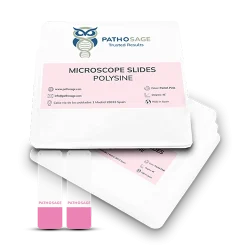
لام پلایزین (°45) برند PathoSage
نمره 0 از 5Intended use:
Polysine microscope slides have a special coating that enhances tissue adhesion by creating a permanent positive charge on the slide surface. This allows them to attract and bind tissue sections electrostatically, ensuring samples remain securely attached even under typical laboratory conditions. They are versatile and compatible with automated staining systems, making them ideal for various applications, including immunocytochemical and molecular hybridization assays. Overall, polysine slides improve staining quality, maintain sample integrity, and enhance diagnostic accuracy and research findings.
-
PSW
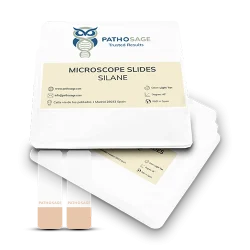
لام سیلانه (°45) برند PathoSage
نمره 0 از 5Intended use:
Silane microscope slides are produced through a process that involves cleaning, coating, curing, and quality control steps. These slides have enhanced adhesion properties due to a silane coating that creates a permanent positive charge on the slide’s surface. This coating significantly improves tissue and cytology section adhesion, ensuring uniform reagent coverage and better staining quality. Silane slides are versatile, durable, and compatible with automated staining systems, making them ideal for various laboratory applications. They form stable covalent bonds with tissues, providing a robust and chemically resistant attachment compared to positive-charged slides.
-
PSW
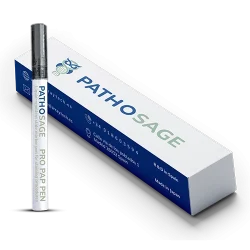
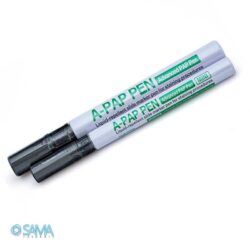
ماژیک IHC مدل PRO PAP PEN برند PathoSage
نمره 0 از 5Intended use:
PathoSage PRO PAP PEN minimizes the consumption of liquid for immunostaining by using this PAP PEN as a “fence” on slide glass. It is very easy to use. You only draw a circle around tissue by this pen on slide glass. Then, a fence is created on the slide glass to prevent overflow of liquid for immunostaining. Two pen tip sizes, 4mm(Regular) and 2mm (Mini).
How to Use
Before first use:
1. Before first use, hold the pen tip upside and press the tip down for air vent.
2. Hold the pen upright to press the tip down only once until the tip becomes saturated.
3. Do 1 again to reject ink on the tip holder, and wipe overflowing ink around the tip.
4. Remove the ink that has just come out first time.
* Be sure to close the cap after use.
Precautions for use:
When using for the first time, follow the instructions on the pen body to bleed air before using.
Please perform the dyeing work after the ink has dried well.
If too much ink comes out, wipe it off.
It will not function if the surfactant remains on the glass after immersion in PBS.
Wipe it off or immerse the glass in a buffer solution that does not contain a surfactant and let the surfactant flow.
-
PSW
تیغ میکروتوم مدل LH35 برند PathoSage
نمره 0 از 5Intended use:
This low profile hard tissue microtome blades is intended for use in histology and pathology laboratories for the precise sectioning of hard or dense tissue specimens with increased durability. It is designed for compatibility with standard rotary microtomes that accept low profile blades. The blade’s optimized edge geometry and hardened stainless steel construction ensure consistent, high quality sections with minimal compression or artifact, supporting accurate microscopic analysis in clinical and research settings. Average number of slices per blade with 3 micron is 30 slices. Hard Tissue examples:- Bone (e.g., osteosarcoma, metastatic carcinoma)
- Teeth (e.g., odontogenic tumors, dental pathology)
- Calcified Cartilage (e.g., osteoarthritis studies)
- Calcified Arteries (e.g., atherosclerotic plaques)
- Tumor Microcalcifications (e.g., breast cancer IHC analysis)
-
PSW
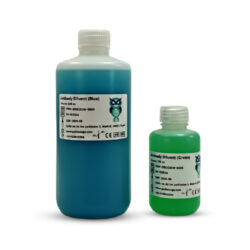
بافر Antibody Diluent برند PathoSage
نمره 0 از 5Intended use:
PathoSage Antibody Diluent is intended for use in immunohistochemistry for the dilution of semi-quantitative detection of Rabbit, Mouse or Goat antibodies. For in vitro diagnostic use (IVD).
Features
- Application: Universal diluent for concentrated primary antibodies in IHC
- Composition: Contains Bovine Serum Albumin (BSA). Suitable for diluting various antibodies (e.g., Rabbit, Mouse and Goat derived antibodies)
- Features: PBS-based with Tween 20. Formulated to stabilize antibodies and reduce background in immunohistochemistry staining
- Advantages: Allows omission of the blocking step before applying primary antibodies
- Format: Ready to use. Should not be diluted
-
PSW
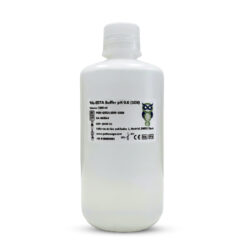
بافر Tris-EDTA برند PathoSage
نمره 0 از 5Intended use:
PathoSage Tris-EDTA Buffer is intended for in vitro diagnostic (IVD) use in immunohistochemistry (IHC) procedures to perform Heat-Induced Epitope Retrieval (HIER) on formalin-fixed, paraffin-embedded (FFPE) tissue sections. This retrieval step is performed prior to the application of primary antibodies, in order to unmask antigenic sites that may have been altered or masked during tissue fixation and embedding. The use of this buffer enhances epitope availability and improves antibody binding, resulting in stronger and more specific.
Features
- Buffer Type: Tris-EDTA
- Form: Liquid concentrate
- Concentration: 10X
- Dilution Ratio: 1:10
- Diluent: Deionized Water
- pH (after dilution): 9.0 ± 0.3
- Maximum Usage (After Dilution): Up to 3 runs within 5 days
- Appearance: Clear, colorless to slightly yellow solution
-
PSW
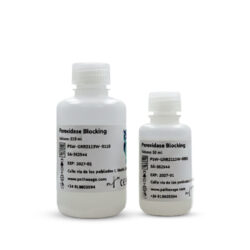
بافر Peroxidase Blocking برند PathoSage
نمره 0 از 5Intended use:
PathoSage Peroxidase Blocking Solution is intended for Research Use Only in immunohistochemistry (IHC) procedures on formalin-fixed, paraffin-embedded (FFPE) tissue sections. This reagent is designed to block endogenous peroxidase activity, thereby minimizing nonspecific background staining. Its application prior to incubation with primary and secondary antibodies ensures improved signal-to-noise ratio and enhances the specificity and clarity of IHC staining results.
Features
- Type: Peroxidase Blocking Reagent (Hydrogen Peroxide-based)
- Form: Ready-to-use liquid
- Compatibility: Suitable for HRP-based detection systems in immunohistochemistry
- Incubation Time: 10 minutes at room temperature
- Stability: Highly stable formulation, non-flammable, reduced toxicity compared to H₂O₂/methanol
- Appearance: Clear, colorless solution
-
PSW
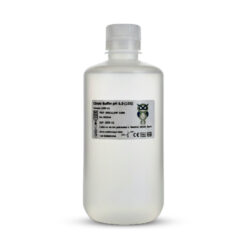
بافر Citrate Buffer برند PathoSage
نمره 0 از 5Intended use:
PathoSage Citrate Buffer is intended for in vitro diagnostics (IVD) use in immunohistochemistry (IHC) for Heat-Induced Epitope Retrieval (HIER) on formalin-fixed, paraffin-embedded (FFPE) tissue sections prior to antibody application. HIER is used to unmask antigenic epitopes that may be masked during formalin fixation and paraffin embedding. This process enhances epitope availability and improves the specificity and intensity of antibody staining.
Features
- Buffer Type: Citrate buffer
- Form: Liquid concentrate
- Concentration: 10X
- Dilution Ratio: 1:10
- Diluent: Deionized Water
- pH (after dilution): 6.0 ±0.3
- Maximum Usage (After Dilution): Up to 3 runs within 5 days
- Appearance: Clear, colorless to slightly yellow solution
-
PSW
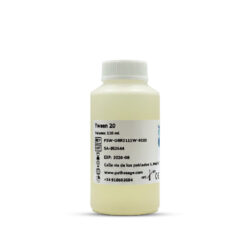
بافر Tween 20 برند PathoSage
نمره 0 از 5Intended use:
PathoSage Tween 20 is intended for use as a non-ionic surfactant in immunohistochemistry (IHC) protocols, particularly in wash buffers and antibody diluents, to reduce non-specific background staining caused by hydrophobic protein interactions. It promotes uniform reagent distribution across the tissue section, improving overall staining consistency and intensity. Tween 20 is suitable for both manual and automated staining platforms, and enhances the penetration and removal of unbound antibodies or detection reagents, thereby contributing to cleaner and more specific immunostaining results. This product is not intended for diagnostic or therapeutic use in humans or animals. For Research Use Only.
Features
- Chemical Name: Polyoxyethylene (20) sorbitan monolaurate
- Synonyms: Polysorbate 20, Tween 20
- CAS Number: 5-64-9005
- Odor: Odorless or slight characteristic odor
- pH (1% solution): 5.0 – 7.5
- Solubility: Soluble in water, ethanol, and most aqueous buffers
- Grade: Molecular Biology / IHC Grade
- Appearance: Clear to slightly yellow, viscous liquid
-
PSW
بافر Citrate EDTA برند Quartett
نمره 0 از 5The buffer is used for rinsing and as a liquid for wash baths in immunohistochemical and histochemical staining techniques. Citrate buffer with additional EDTA
(Ethylenediaminetetraacetic acid) and pH 7.5 is used to improve tissue decalcification. -
PSW
بافر EDTA برند Quartett
نمره 0 از 5The ready to use buffer is applied as a solution for rinsing and wash baths as well as antigen unmasking in immunohistochemical and histochemical staining techniques.
-
PSW
بافر PBS برند Quartett
نمره 0 از 5Phosphate buffered saline (PBS) is a commonly used buffer for biological and IHC applications. PBS is used for all processes that require a salt concentration close to the physiological state, adapted to the pH value required in histology or in cell culture techniques. PBS is mainly used as a wash buffer in histology, serology, cell culture, biochemical assays (ELISA, RIA) and protein purification. Phosphate buffers should not be used in enzyme assays where competition for phosphate groups or complexation with a metal ion is essential for enzyme activation.